
Funeral Flower Etiquette: What to Send, When, and What They Mean
A complete guide to funeral flower etiquette — which arrangements to send, what to write on the card, colour meanings, timing, cultural traditions, and cremation flower guidelines.
Funeral flower etiquette centres on three decisions: choosing an arrangement appropriate to your relationship with the deceased, timing delivery so it arrives before the service begins, and including a card message that names who the flowers are from and offers a brief, sincere expression of sympathy. Get those three right and your tribute will be received exactly as you intend it.
This guide covers everything beyond those basics — the symbolic meaning of each flower type and colour, what to write on the card (with ready-to-use examples), which arrangements are reserved for immediate family versus friends and colleagues, how etiquette differs for cremations and memorial services, and what to do when the obituary says "in lieu of flowers." Whether you are ordering a standing spray for a funeral home or sending a peace lily to someone's doorstep three weeks later, the guidance here will help you choose with confidence.
If you are also looking for guidance on what to say in person at the service, our companion guide on what to say at a funeral covers that in full.
Key Takeaways
Match the arrangement to your relationship — casket sprays are reserved for immediate family; friends and colleagues typically send standing sprays, wreaths, or smaller bouquets
Timing matters — arrange delivery to the funeral home at least 2-3 hours before the first scheduled event; late arrivals create logistical stress for already grieving families
Always include a signed card — funeral directors report that unsigned arrangements are one of the most common sources of distress; identify yourself clearly
White is universally safe — white lilies, roses, and chrysanthemums convey peace and reverence across nearly every cultural tradition
"In lieu of flowers" should be honoured — if the family has requested donations instead, respect their wishes; a small plant to the home weeks later is a thoughtful compromise
Cremation services follow the same etiquette — flowers are appropriate at cremation ceremonies; only skip them if the family explicitly requests no flowers
Best Flowers for a Funeral and What They Mean
Choosing the best flowers for a funeral starts with understanding the language that has developed around specific blooms over centuries. Funeral directors and floral designers consistently recommend the following flowers for their symbolic resonance, their ability to hold up during a service, and their universal appropriateness across most cultural contexts.
Lilies
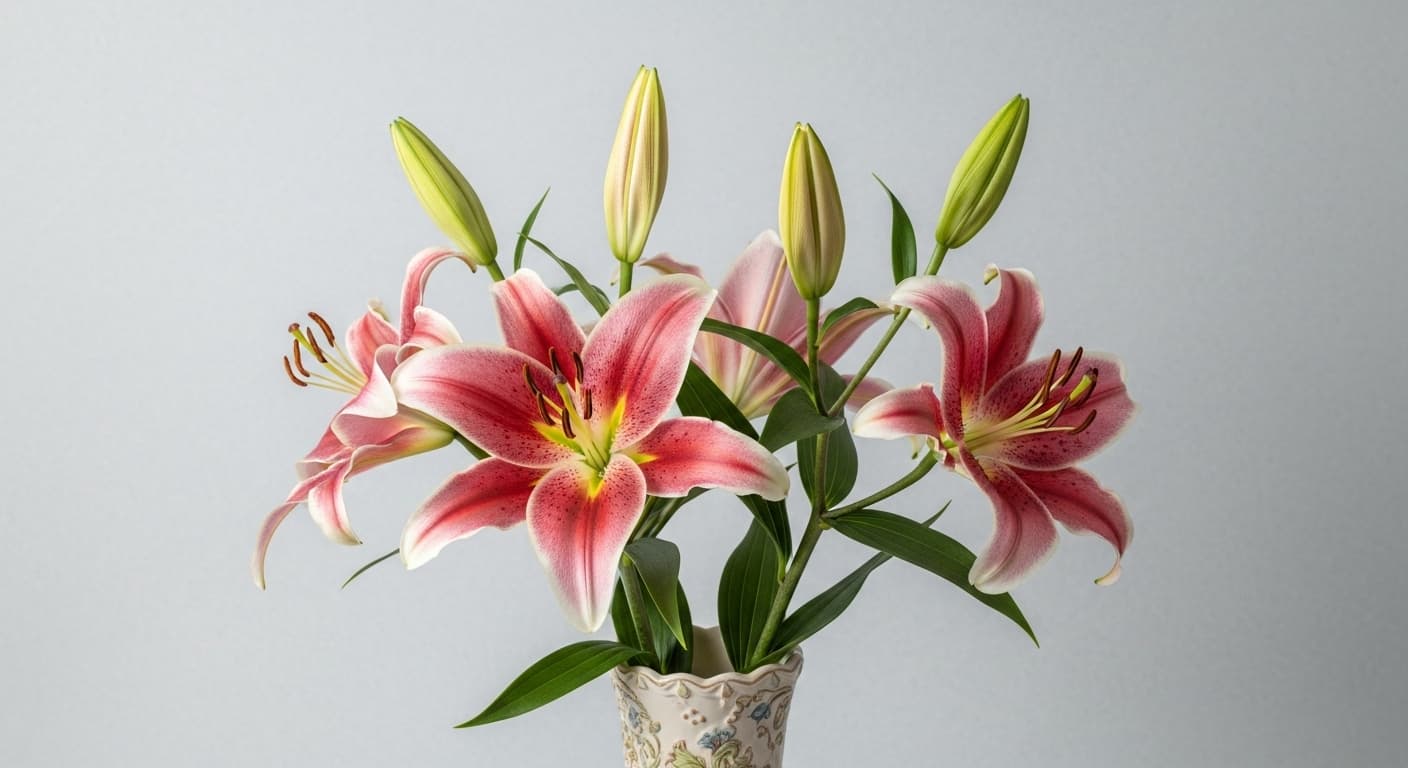
White lilies — particularly Casablanca and stargazer varieties — are the single most associated flower with funerals in Western tradition. They symbolise the restored innocence of the soul of the departed. Their large, dramatic blooms fill a room with fragrance and presence. If you are unsure what to send and want a safe, meaningful choice, white lilies are almost always appropriate.
Roses
Roses carry layered meanings depending on colour. White roses convey reverence, innocence, and humility. Red roses express deep love, courage, and respect — often chosen by a spouse or partner. Pink roses signify grace, admiration, and gratitude for a life well lived. Yellow roses, while traditionally associated with friendship and warmth, are sometimes avoided in funeral contexts in certain cultures, so white or pink are generally safer choices.
Carnations
Carnations are one of the longest-lasting cut flowers, making them practical as well as symbolic. Red carnations express deep love and affection. Pink carnations symbolise remembrance — the National Funeral Directors Association notes they are among the most frequently requested flowers for memorial services. White carnations represent pure love and innocence.
Chrysanthemums
In the United States, chrysanthemums (mums) convey honour, loyalty, and sympathy. In many European and Asian cultures, they are the quintessential funeral flower — in countries like France, Italy, Japan, and Korea, chrysanthemums are reserved almost exclusively for mourning. If you are sending flowers to a family with European or Asian heritage, white chrysanthemums are an especially thoughtful choice.
Gladioli
Gladioli represent strength of character, sincerity, and moral integrity. Their tall, stately form makes them popular in standing sprays and large arrangements displayed near the casket. They communicate that the deceased was a person of substance.
Orchids
Orchids — especially white phalaenopsis — convey enduring love and refined beauty. As potted plants, they offer a lasting tribute the family can keep at home for years. Orchids are increasingly popular at modern memorial services and celebrations of life.
What Colour Flowers for a Funeral: A Quick Reference
White — peace, purity, reverence. Universally appropriate and always safe.
Red — deep love, courage, respect. Typically from a spouse, partner, or very close family.
Pink — grace, admiration, gentle love. Appropriate from anyone; especially common for mothers and grandmothers.
Yellow — friendship, warmth, devotion. Generally appropriate in the US; avoid in some European and Latin American traditions where yellow signifies jealousy.
Purple or lavender — dignity, devotion, spirituality. Often chosen for religious services or when the deceased had a strong faith.
Blue — calm, tranquillity, remembrance. Less traditional but increasingly popular at celebrations of life.
Mixed arrangements — perfectly appropriate. A mix of white, pink, and lavender is a classic sympathy combination.
Types of Funeral Flower Arrangements and Who Sends Them
One of the most frequently asked questions about flowers at a funeral is which arrangement type is appropriate for your relationship with the deceased. Getting this right avoids an awkward overstep — like sending a casket spray when you are a colleague — or an understated gesture when you are close family. Funeral homes and event coordinators use the following general framework.
Casket Sprays
These large, dramatic arrangements sit on top of the closed casket (full couch) or on the lower half of an open casket (half couch). Casket sprays are almost always purchased by the immediate family — typically the spouse, children, or parents of the deceased. They are the most personal and prominent floral tribute at a service. If you are not immediate family, do not order a casket spray unless the family has specifically asked you to.
Standing Sprays and Wreaths
Displayed on easels near the casket or at the entrance of the service, standing sprays and wreaths are the most common arrangement sent by extended family, close friends, work teams, and community groups. Wreaths carry the added symbolism of eternal life — the unbroken circle representing continuity. Standing sprays typically include a ribbon with a message such as "Beloved Brother" or "With Deepest Sympathy."
Funeral Baskets and Bouquets
Smaller, freestanding arrangements are appropriate from friends, acquaintances, neighbours, and colleagues. Baskets are self-contained and do not require a vase, making them practical for display at the funeral home. Bouquets sent to the family's home after the service are a thoughtful alternative — particularly for people who were unable to attend.
Living Plants
A potted peace lily, orchid, or small tree offers a lasting tribute that the family can nurture for years. Living plants are particularly appropriate when sent to the home rather than the funeral venue. They symbolise enduring life and growth — a reminder that something living continues after the loss. For an even more lasting living tribute, consider planting a memorial tree in their honour.
Sympathy Bouquets Sent to the Home
These are distinct from funeral arrangements in both timing and intent. Sent to the bereaved person's home in the days or weeks after the service, they communicate ongoing support rather than formal tribute. Grief counselors note that support arriving after the initial wave of condolences has subsided is often the most meaningful — the house has emptied, the calls have slowed, and a fresh bouquet at the door can feel like a lifeline.
How to Send Flowers to a Funeral Home
Confirm the funeral home and service time
Check the obituary or funeral notice for the exact name and address of the funeral home, as well as the dates and times of the visitation, service, or both. If there are multiple locations (e.g., a church service and a separate reception), send flowers to the primary venue unless you have been told otherwise.
Order from a local florist or reputable online service
Local florists near the funeral home are often the best choice — they know the venue's delivery procedures and can guarantee freshness. If ordering online, choose a service that partners with local florists rather than shipping flowers long-distance. Specify that the delivery is for a funeral and provide the deceased person's full name.
Time delivery for 2-3 hours before the first event
Funeral homes are accustomed to receiving floral deliveries and will arrange them for display. Aim for arrival at least 2-3 hours before the visitation or service begins. Deliveries that arrive during or after the service create logistical challenges for staff and can go unnoticed by the family.
Address the arrangement correctly
Always address funeral flowers to the funeral home, with the deceased person's name noted on the order — for example, "For the service of Margaret Chen." Do not address them to the family's personal name. Include a signed card with a brief, sincere message. Funeral directors report that unsigned arrangements are one of the most common issues they encounter.
Follow up if sending to the family's home instead
If you prefer to send flowers or a plant to the family's home — particularly after the service — confirm they will be home to receive the delivery. A text message to a mutual contact is usually sufficient. Sending a plant or bouquet one to three weeks after the funeral is entirely appropriate and often deeply appreciated.
What to Write on Funeral Flowers: Card Messages That Feel Right
Knowing what to write on funeral flowers can feel as difficult as choosing the arrangement itself. The card that accompanies your flowers is often kept by the family long after the blooms have faded — funeral directors consistently report that families read every card, sometimes multiple times, in the weeks that follow. Keep your message brief, sincere, and specific to the relationship.
Below are ready-to-use messages grouped by situation. Every one is written to be used verbatim — no fill-in-the-blank placeholders.
General Sympathy Messages
1. "With deepest sympathy and heartfelt condolences. You are in our thoughts."
2. "Thinking of you during this difficult time. We are so sorry for your loss."
3. "In loving memory. May these flowers bring a small measure of comfort."
4. "Our hearts go out to you and your family. With love and deepest sympathy."
5. "Wishing you peace and comfort during this time of sorrow. You are not alone."
Messages from Family
6. "To our beloved uncle — your kindness shaped our whole family. We carry your love always."
7. "For Grandma, who taught us that love is the only thing that lasts. We miss you more than words can hold."
8. "Dad, your strength lives on in all of us. Rest peacefully. With all our love, your children."
Messages from Colleagues and Acquaintances
9. "On behalf of the entire team at [company name], please accept our sincere condolences. Your contributions and presence are deeply missed."
10. "We were so sorry to hear of your loss. Please take all the time you need, and know that we are thinking of you."
11. "With sympathy from your neighbours on [street name]. We are here if there is anything at all we can do."
What to Say on Funeral Flowers from a Close Friend
When you are a close friend, what to say on funeral flowers should be personal rather than formal. Mention the person by name if you can — it signals that your tribute is for this specific life, not a generic gesture.
12. "I will miss her every single day. The world was better with Margaret in it, and everyone who knew her knows that."
13. "Your friendship meant the world to him. These flowers are a small reflection of the enormous love he carried for you."
14. "There are no words. Just know that I am here, I am heartbroken alongside you, and I am not going anywhere."
For a more comprehensive collection of sympathy messages for different relationships, see our guide on what to write in a sympathy card.
“The flower that follows the sun does so even in cloudy days. Grief is like that — it turns toward love even when the light feels distant.”
Cultural and Religious Funeral Flower Traditions
Funeral flower customs vary significantly across cultures and faiths. Sending the wrong type of arrangement — or sending flowers at all when the tradition calls for something else — can inadvertently cause discomfort. Bereavement professionals advise checking with a family member or the funeral home if you are unsure of the family's traditions.
Christian Services
Flowers are widely welcomed and expected at Christian funerals. Lilies are especially common due to their association with resurrection and purity. White flower arrangements dominate, though mixed colours are also appropriate. Crosses and heart-shaped wreaths are traditional and meaningful.
Jewish Funerals (Shiva)
Traditional Jewish practice discourages sending flowers to the funeral or burial service. Instead, send a donation to a charity specified by the family, or bring food to the home during the shiva period (the seven days of mourning following burial). If you are certain the family would welcome flowers — some less observant families do — send them to the home rather than the synagogue.
Islamic Services
Islamic funeral traditions generally discourage elaborate floral displays. Simple white flowers placed near the grave are sometimes acceptable, but charitable donations in the name of the deceased are the preferred expression of sympathy. When in doubt, contact the mosque or the family directly.
Hindu and Buddhist Ceremonies
White flowers are traditional in both Hindu and Buddhist funeral customs. Chrysanthemums, lotus flowers, and white orchids are commonly used. In Hindu tradition, flower garlands (malas) may be placed on the body or casket. Avoid bright, celebratory colours unless the family indicates a celebration of life format.
East Asian Traditions
In Chinese, Japanese, and Korean funeral customs, white and yellow chrysanthemums are the primary funeral flower. In China, white is the colour of mourning (not black), so white flowers are preferred over any other colour. Avoid red flowers entirely — red symbolises happiness and celebration in Chinese culture and is considered inappropriate at funerals. In Japan, white lilies and chrysanthemums are standard, and arrangements are typically simple and elegant rather than large and dramatic.
Cremation Flower Etiquette: Do You Send Flowers for a Cremation?
One of the most common questions about cremation flowers etiquette is whether flowers are appropriate at all. The answer is yes — flowers are welcome at most cremation services, memorial services, and celebrations of life. The etiquette is largely the same as for a traditional burial service, with a few differences.
If there is a formal viewing or visitation before the cremation, flowers are displayed in the same way as at a traditional funeral — standing sprays near the casket, wreaths at the entrance, and baskets throughout the room. If the service is a memorial without the body present, arrangements are typically placed around a photo, urn, or memory table.
Some families request that guests bring a single flower to place in a communal vase during the service — a meaningful ritual that allows everyone to participate. Others ask that flowers be sent to the home after the service instead. Check with the funeral home or the family's point of contact if you are unsure.
Living plants are an especially thoughtful choice for cremation services, as they offer the family something to take home and nurture — a growing reminder of the person they have lost.
Common Funeral Flower Mistakes (and How to Avoid Them)
Most guides on funeral flower etiquette cover what to do. Fewer cover what actually goes wrong. In our experience helping families through memorial planning, these are the mistakes that cause the most distress — and they are all easily avoided.
Sending flowers without a card. This is far more common than people realise. The family receives a beautiful arrangement with no indication of who sent it. They have no way to send a thank-you note, and the gesture — however generous — feels incomplete. Always include a signed card, even if the message is just your name and "With deepest sympathy."
Choosing an arrangement that oversteps your relationship. A casket spray from a coworker or a distant relative can create confusion and even resentment among the immediate family. When in doubt, a standing spray, wreath, or simple basket is always appropriate regardless of your relationship.
Delivering flowers to the wrong location. If the obituary lists both a funeral home and a church, send flowers to whichever location will host the primary service or visitation. If you are unsure, call the funeral home — they coordinate deliveries regularly and can advise you.
Ignoring "in lieu of flowers" requests. When a family has asked for donations instead of flowers, honour that request. Sending a large arrangement despite the request can feel dismissive of the family's wishes. If you still want to send something tangible, a small potted plant to the home a few weeks later is a gentle compromise that most families appreciate.
Forgetting that support does not end at the funeral. Grief counselors note that the weeks and months after a funeral are often when the bereaved feel most alone — the cards stop, the calls slow down, and daily life resumes for everyone except the person who is grieving. Sending flowers or a plant two or three weeks after the service communicates that you have not forgotten. It is one of the most meaningful gestures you can make.
What to Do When the Obituary Says "In Lieu of Flowers"
This phrase appears in obituaries more frequently than ever, and it can leave people unsure of what to do instead. The guidance from funeral professionals is straightforward: respect the family's wishes. "In lieu of flowers" typically means the family prefers donations to a specified charity, contributions to a memorial fund, or alternative gestures of support.
- Make a charitable donation to the organisation named in the obituary. Most will send an acknowledgment card to the family notifying them of your gift.
- Bring food to the family's home — a home-cooked meal, a gift card to a local restaurant, or a prepared meal delivery service subscription can be profoundly helpful in the weeks after a loss.
- Offer a specific act of service — mowing the lawn, driving children to school, sitting with the bereaved when they do not want to be alone. Specific offers are far more useful than "let me know if you need anything."
- Send a living plant weeks later — a small orchid, succulent, or peace lily delivered to the home two to three weeks after the service is a gentle way to show continued support without contradicting the family's request.
- Create a digital memorial — a memorial page gives family and friends a lasting space to share stories, photos, and messages, keeping the person's memory alive well beyond the service.
Sending Sympathy Flowers Online: What to Look For
When sending condolence flowers online, the quality and reliability of the delivery service matter as much as the flowers themselves. A late or damaged delivery at a funeral is worse than no delivery at all. Here is what to look for when ordering.
- Local florist partnerships — services that route orders to local florists near the funeral home ensure same-day freshness and reliable delivery timing.
- Funeral-specific delivery options — look for services that ask for the deceased person's name and the funeral home address, not just a generic delivery address.
- Clear delivery windows — confirm that the service can deliver before the service begins, not just "same day."
- Card customisation — ensure you can write a personal message rather than selecting a pre-written template.
- Reviews and reliability — check reviews specifically for funeral deliveries, as these have no margin for error.
On MemoriTree, you can send sympathy flowers directly alongside creating a memorial page — combining a physical tribute with a lasting digital space where the family can receive condolences, share photos, and keep stories alive for years to come.
Honour Their Memory with Flowers and a Lasting Tribute
Send sympathy flowers through MemoriTree, and pair them with a digital memorial page where family and friends can share stories, photos, and messages for years to come. Every memorial also plants a real tree in their honour.
Send Flowers and Create a MemorialMemoriTree
MemoriTree editorial team.