Writing a Beautiful Obituary: 20 Examples for Mother, Father, and More
Read 20 beautifully written obituary examples for mother, father, spouse, grandparent, veteran, child, and friend — plus a complete step-by-step guide to writing one yourself.
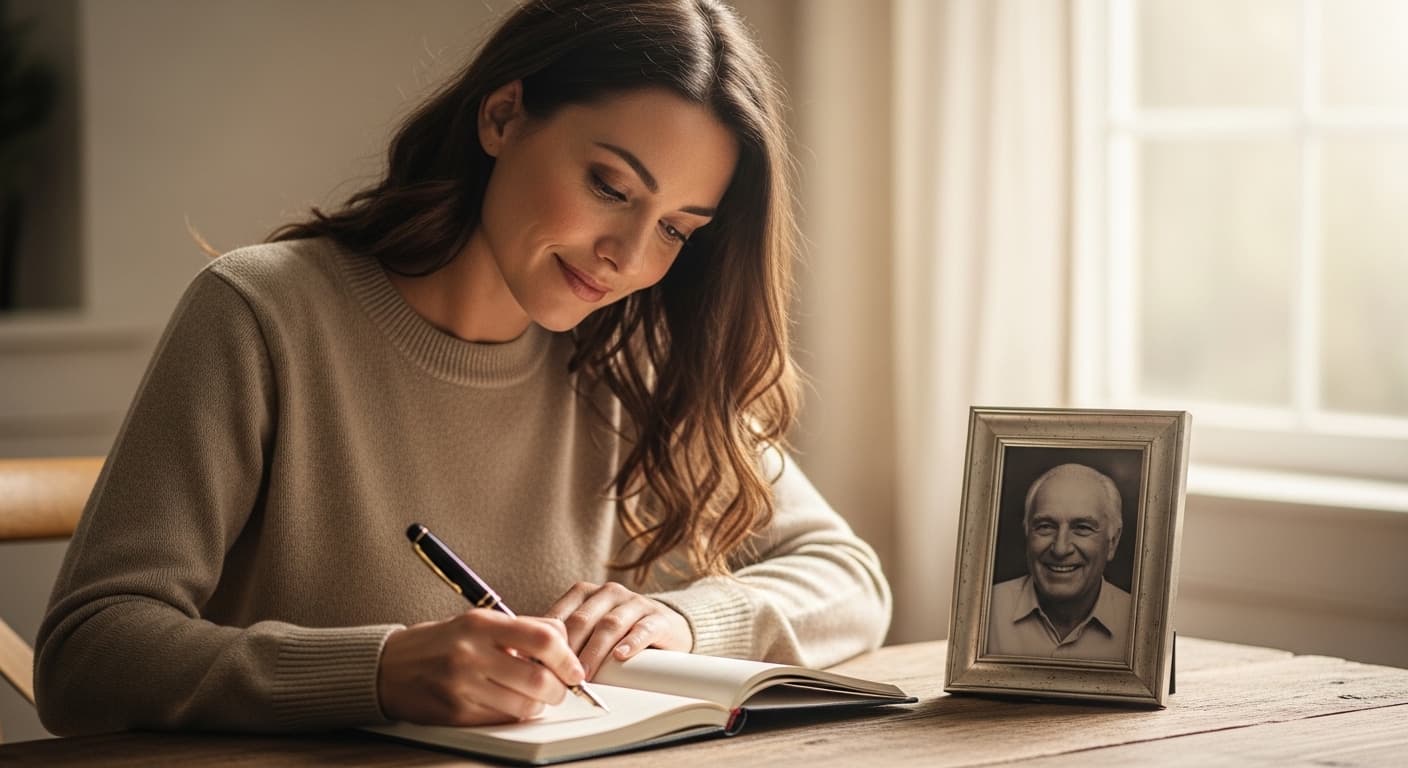
A beautiful obituary does three things: it names who the person was, it captures how they lived, and it gives the people who loved them something to hold onto long after the service is over. It is not a list of dates. It is not a résumé. It is a piece of writing that says, without apology, that this person mattered.
Below you will find 20 fully written obituary examples across seven relationships — mother, father, spouse, grandparent, veteran, child, and friend — along with a complete step-by-step guide to writing your own. Every example is ready to read as inspiration or to adapt with specific details. None contain fill-in-the-blank placeholders.
If you need a broader collection of formats and styles, our guide to 30 obituary examples covers additional relationship types and tones. For the structural rules of obituary writing, see the obituary format guide. If you want to start from a pre-built framework, use our free obituary template or generate one instantly with our free obituary maker.
Key Takeaways
Lead with the person, not the dates — open with a sentence that captures their character, not their birth year
Specific details outperform general adjectives — "she made lemon cake every Sunday" says more than "she was warm and caring"
The voice should match the life — a formal obituary for a judge reads differently from a casual one for a lifelong jokester; both are correct
Include survivors and predeceased with care — list family in consistent order and double-check spellings before submitting to a newspaper
Length is flexible — a powerful obituary can be three sentences or three pages; newspapers typically charge by the word, so a 250-word version is often the published form
Write a draft before editing — trying to write and edit simultaneously produces stilted prose; get the memories down first, then shape them
You are allowed to grieve while writing — the process is hard; it is also an act of love
How to Write a Beautiful Obituary: 6 Steps
Gather the facts before you write a single word
Before opening a blank document, collect the essentials: full name (including maiden name), date and place of birth, date and place of death, occupation and career highlights, education, military service, significant relationships (spouse, children, grandchildren, siblings, parents if predeceased), hobbies and passions, community involvement, and the funeral service details. Having this information to hand means you can write continuously rather than stopping to search. Our full-length obituary format guide explains which facts are considered essential and which are optional.
Open with a sentence that captures who they were
The first sentence sets the tone for everything that follows. Resist the urge to begin with "It is with great sadness that we announce..." — this phrasing is so common it has become invisible. Instead, lead with something true and specific: "Margaret Okafor spent sixty years teaching mathematics to reluctant teenagers, and she turned most of them into enthusiasts." That sentence tells you more about a person than a paragraph of conventional opening phrases ever could. The opening should earn the reader's attention and reward anyone who knew the person.
Build the life narrative in the middle section
The body of the obituary is where you tell the story of a life. Move roughly chronologically — childhood, education, career, family, later years — but do not feel trapped by timeline. Anecdotes can interrupt the sequence when they illuminate character. Include the details that made the person specific and irreplaceable: the morning ritual, the particular laugh, the thing they always said. Avoid a list of jobs and committee memberships unless those roles genuinely defined the person. The goal is recognition: someone who loved them should read it and think, yes, that was exactly who she was.
List survivors and predeceased family
Convention places the survivors section near the end: "She is survived by her husband of 42 years, David; her children Elena (married to Thomas) and Marcus; four grandchildren; and her sister Ruth." Those predeceased are listed separately: "She was preceded in death by her parents, Joseph and Clara, and her brother William." Check every spelling. In newspaper publication, a misspelled name in an obituary is one of the most painful errors a family can experience. For online memorials there is no word limit, so this section can be more expansive.
Close with something that endures
The closing of an obituary is your final opportunity to say something meaningful. A service announcement is fine to include, but it should not be the last sentence — it makes the obituary end on logistics rather than on the person. Close instead with something that will age well: a line about how they will be remembered, a short phrase that captures their spirit, or a sentence addressed directly to the people they loved. "She always said the door was open. It still is." This kind of closing is what people underline.
Edit, then share before you submit
Read the draft aloud — this is the single most effective editing technique for obituary prose, because awkward sentences announce themselves immediately when spoken. Then share it with one or two family members who knew the person well and ask them: does this sound like them? Is there anything important missing? Is there anything here that would have made them wince? Make revisions based on this feedback, not on the desire to please everyone. A final proofread for dates, name spellings, and factual accuracy is essential before submitting to a newspaper or posting online.
Obituary Examples for a Mother
Writing an obituary for your mother is one of the most emotionally demanding pieces of writing most people will ever attempt. The examples below are written at different lengths and in different voices — formal, warm, conversational — to reflect the range of women and the range of families who survive them. For further inspiration, see our companion guide on eulogy examples for a mother.
Example 1 — The Devoted Home Builder
Eleanor Ruth Whitfield, 82, of Portland, Oregon, passed away peacefully on March 14, 2026, surrounded by the family she spent a lifetime building. Born in 1943 in rural Tennessee, Eleanor made her way to Oregon in her mid-twenties with forty dollars, a sewing machine, and a certainty that things would work out. She was right.
Eleanor raised four children in the same house on Maple Street where she had lived since 1971. Every Saturday morning smelled like cinnamon rolls. She kept a vegetable garden until she was seventy-eight. She mended things — clothes, arguments, hurt feelings — with equal patience and skill. Her children describe a woman who never raised her voice when a quiet word would do more.
She is survived by her husband of 59 years, Robert; her children James, Carol (Hensley), David, and Patricia (Wu); nine grandchildren; and two great-grandchildren. She was preceded in death by her parents and her sister Dorothy.
A memorial service will be held Saturday at 11 a.m. at First Presbyterian Church, Portland. In lieu of flowers, the family asks for donations to the Oregon Food Bank, which Eleanor supported for thirty years. The cinnamon roll recipe will be shared at the service.
Example 2 — The Career Woman and Force of Nature
Dr. Vivienne Clarke, 71, thoracic surgeon, mother, and relentless advocate for working-class children in the British healthcare system, died on March 12, 2026, in London. She did not do anything quietly, and her passing has not been quiet either.
Vivienne grew up in Brixton, the eldest daughter of Jamaican immigrants who told her consistently that the system was not designed for her and that she should take it apart from the inside. She took their advice literally. By thirty-five she was one of the most respected cardiothoracic surgeons in the country. By forty she had founded a mentorship programme that has since placed over 300 young people from low-income backgrounds into medical training.
She was a demanding mother — her daughters would be the first to say so — and an irreplaceable one. She taught them that excellence and compassion were not in conflict, and she modelled both daily. She is survived by her daughters Serena and Imogen, her son-in-law David, and two grandchildren who called her Nana Viv and were slightly terrified of disappointing her.
A celebration of life will be held at the Royal College of Surgeons on April 5. Donations to the Clarke Foundation may be made at clarkefoundation.org.uk.
Example 3 — The Quiet, Steady Presence
Ruth Anne Kowalski, 78, died on March 10, 2026, at home in Milwaukee, in the bedroom where she had slept for fifty years. Those who knew her will say that she would have preferred it that way.
Ruth was not a woman who sought the spotlight. She taught second grade for thirty-one years, attended every school concert her children were ever in, kept a meticulous garden, and made the best pierogi in the extended family — a title she held without dispute and with considerable quiet pride. She read a book a week until the end of her life and had strong opinions about which ones were worth recommending and which were not.
Her children remember a mother who listened more than she spoke, who remembered every detail of what mattered to the people she loved, and whose silence in a room was never empty. She is survived by her children Michael, Anne (Petrov), and Thomas; seven grandchildren; and her sister Helen. She was preceded in death by her husband of 44 years, Edward, and her parents.
Funeral Mass will be held at St. Stanislaus Church on Thursday at 10 a.m. Burial will follow at Holy Cross Cemetery.
Obituary Examples for a Father
The obituaries below approach a father's life from different angles — the provider, the outdoorsman, the gentle intellectual. All three are complete and ready to adapt.
Example 4 — The Provider and Patriarch
Harold James Oduya, 80, of Houston, Texas, died on March 15, 2026, having provided for his family for fifty-eight years without complaint and with a great deal of purpose. He was the kind of man who showed love through action — a leaking roof fixed before anyone noticed it was leaking, a tuition cheque written without asking to be thanked, a drive across town at midnight because someone needed him.
Harold was born in Lagos in 1945 and arrived in Texas in 1968 with an engineering degree and an accent people underestimated for exactly as long as it took him to open his mouth. He retired at seventy-two as a senior project manager at an energy company where he had spent thirty-five years, earning the respect of everyone who worked with him and the affectionate nickname "The Professor" for his habit of turning every conversation into a learning opportunity.
He is survived by his wife of 53 years, Abigail; his children Nathaniel, Lola (Chambers), and Isaiah; and six grandchildren who had every one of his engineering lectures memorised and loved him deeply anyway. Funeral service will be held Saturday at 2 p.m. at Antioch Baptist Church.
Example 5 — The Outdoorsman and Adventurer
Frank William Buchanan, 74, of Bozeman, Montana, died on March 9, 2026, which his family suspects he would have accepted as a reasonable outcome of a life lived outdoors in all weathers. Frank did not stay inside if he could help it.
He hiked every major trail in the Rockies before he was forty and returned to most of them in the decades after. He fished with his children every summer without fail. He built the cabin on Flathead Lake with his own hands and the help of his brother-in-law, who still takes credit for the roof. He coached youth baseball for sixteen years and, by his own count, turned out two decent shortstops. He was a man of few words in meetings and many words beside a fire.
Frank is survived by his wife Sandra; his children Greg, Tessa (Rowe), and Ben; and five grandchildren who are all decent hikers and at least two of whom are decent fishers. He was preceded in death by his parents and his brother Tom. A service will be held at the cabin on Flathead Lake on April 12, weather permitting, which is how Frank would have wanted it.
Example 6 — The Gentle Intellectual
Professor Leonard Ashby, 85, died on March 13, 2026, in Cambridge, Massachusetts, where he had lived and taught for fifty-three years. He was a professor of medieval history whose students consistently rated him as the best teacher they had encountered and whose office was so full of books that visiting it required a navigational strategy.
Leonard was generous with his knowledge and his time in ways that left no record except in the people he shaped. He mentored dozens of graduate students over his career, many of whom have gone on to distinguished academic lives of their own. He was also, to the great benefit of his children, a man who brought the same patience and curiosity to fatherhood that he brought to scholarship. He answered every question with a question. It drove them crazy. They have all become people who ask good questions.
He is survived by his wife of 56 years, Caroline; his children Julia, Martin, and Rose (Nakamura); four grandchildren; and several hundred former students. A memorial lecture will be held at the university on April 20. In lieu of flowers, donate to the Ashby Graduate Fellowship fund.
Obituary Examples for a Spouse or Partner
Writing an obituary for a spouse requires acknowledging not just who the person was, but what the partnership was — the shared life that made both people who they became. These two examples try to honour that dimension.
Example 7 — A Long Marriage
Margaret Helen Sinclair, 79, died on March 11, 2026, in Edinburgh, Scotland, forty-eight hours after her husband of fifty-six years, George, whom she had loved since a rainy Tuesday in 1968 when he held an umbrella over her head outside the public library. Her children believe she simply could not imagine going further without him, which is consistent with everything they knew about her.
Margaret was a retired schoolteacher, a devoted grandmother, a gifted baker, and a woman whose capacity for loyalty was total. She and George were inseparable in a way that people sometimes described as old-fashioned and that their children described as the luckiest thing they had ever witnessed. She is survived by her children Helen, Robert, and Andrew; eleven grandchildren; and a family that will spend a long time working out how to hold two absences at once. A joint service will be held Saturday at St. Giles' Cathedral.
Example 8 — A Younger Loss
Daniel Marcus Reeves, 51, died unexpectedly on March 8, 2026, in Chicago. He leaves behind his wife of twenty-two years, Sarah, their children Mia and Owen, a dog named Biscuit who still waits by the front door, and an absence in his household that cannot be described in ordinary words.
Daniel was a construction project manager, a weekend cook of considerable ambition and variable results, a devoted coach to Owen's soccer team, and the kind of husband who remembered every anniversary without being reminded. He was funny in the way that makes people say they did not realise how much they needed to laugh until the laughter stopped. Sarah has asked that those who loved Dan share a memory with her in the weeks ahead — she is collecting them for the children. A celebration of life will be announced. The family is grateful for privacy during this time.
Obituary Examples for a Grandparent
Grandparents often occupy a particular emotional space in a family — witnesses to the whole arc of the family's story, sources of unconditional presence. These examples try to capture that role.
Example 9 — The Beloved Grandmother
Agnes Mary Kowalczyk, 94, died on March 16, 2026, in Cleveland, Ohio, with three of her grandchildren holding her hands, which is the only ending her family can imagine for her. Agnes spent the last decade of her life as the acknowledged centre of a family of thirty-one people, and she held that centre without effort.
Born in Poland in 1931, Agnes survived the Second World War as a child, immigrated to the United States in 1952, and built a life in Cleveland that she rarely left and never stopped being grateful for. She cooked for everyone who came to her door. She kept photographs of every grandchild and great-grandchild in chronological order and could produce any of them from memory on request. She called every grandchild on their birthday without fail and always knew exactly how old they were turning. She outlived two of her four children, a grief she bore without bitterness and without complaint.
She is survived by her children Marta (Kasprzak) and Józef; her ten grandchildren; and fourteen great-grandchildren. Mass of Christian Burial will be celebrated Thursday at 10 a.m. at Sacred Heart Church. She will be laid to rest beside her husband Stefan, who died in 1999 and for whom she never stopped wearing her wedding ring.
Example 10 — The Grandfather Who Built Things
William Thomas Adler, 88, died on March 17, 2026, in Knoxville, Tennessee, in the house he built in 1964. He built it himself, over eighteen months, on evenings and weekends, and he repaired every part of it at least once in the sixty-two years that followed. His grandchildren grew up believing that all houses were built by their grandfathers. It was not until they were considerably older that they realised this was not a universal experience.
William was a carpenter by trade and a craftsman by nature. The furniture in his house and in the houses of all four of his children was made by his hands. He taught every grandchild who showed interest how to use tools correctly, and he taught the ones who showed no interest anyway, on the grounds that it was useful information. He was patient in the workshop and impatient at the dinner table, a distinction his family found both consistent and endearing.
He is survived by his wife of 64 years, Lorraine; his children Robert, Susan (Marshall), Carl, and Janet (Obasi); twelve grandchildren; and three great-grandchildren. A graveside service will be held Friday. In lieu of flowers, the family asks for donations to Habitat for Humanity, which William supported for thirty years.
Obituary Examples for a Veteran
An obituary for a veteran has the particular responsibility of acknowledging their service accurately and respectfully, without reducing the whole person to their military record. Both examples below include the person's service details alongside the fuller life they lived afterward.
Example 11 — Army Veteran, Korea and Civilian Life
Staff Sergeant (Ret.) Howard Allen Campbell, 91, United States Army, died on March 15, 2026, in Richmond, Virginia. He served during the Korean War, was awarded the Bronze Star for meritorious service, and came home in 1953 to build a life in Virginia that lasted seven more decades.
Howard did not speak much about Korea to his children, which was common for men of his generation and which they eventually understood. He spoke about it more as he aged, and what he said was that it made him grateful for ordinary mornings in a way that he found impossible to fully explain. He spent his civilian career as an electrician, raised three children with his wife Louise, and volunteered for thirty years with the local VFW post, where he served as commander for six years. He was the kind of man who stood for the anthem before it was popular to say so and sat with veterans at the VA who had no family to visit them.
He is survived by his children Patricia (Mullins), Steven, and Dale; eight grandchildren; and two great-grandchildren. His wife Louise predeceased him in 2019. Military honours will be rendered at graveside service Friday at 2 p.m. at Arlington National Cemetery.
Example 12 — Navy Veteran and Later-Life Advocate
Petty Officer First Class (Ret.) Carmen Lucia Torres, 68, United States Navy, died on March 14, 2026, in San Diego, California. She served for twenty years, retiring in 2005, and spent the following twenty years doing what the Navy had trained her to do in a different kind of service: she ran a non-profit that placed veteran women into workforce training and sustainable employment.
Carmen was born in San Antonio in 1957, the daughter of a Marine and a schoolteacher, and she joined the Navy at twenty-one with the intention of staying for one tour. She stayed for twenty. She was stationed in Yokosuka, Naples, and San Diego, and she described each posting as an education she was glad to have had. After retirement she earned a master's in social work and dedicated herself to the advocacy that defined the final two decades of her life. Her organisation placed over 1,400 women into employment in twenty years.
She is survived by her husband of 36 years, Ricardo; her children Sofia and Marco; and four grandchildren. A celebration of life will be held at the USS Midway Museum on April 5. In lieu of flowers, donations to the Carmen Torres Foundation for Veteran Women may be made at ctfvw.org.
Obituary Examples for a Child
There is no harder obituary to write. The examples below are written with the understanding that families approaching this task are already carrying an almost unbearable weight. They are intended as a foundation only — a starting point that can be built upon with the specific details that belonged to your child and to no one else. Grief counselors advise that including the child's name repeatedly throughout the obituary is one of the most comforting things a family can do.
Example 13 — A Young Child
Lily Grace Okonkwo, age 4, beloved daughter and sister, died on March 9, 2026. She had lived her four years with an enthusiasm for everything she encountered — caterpillars, bubble wrap, the colour orange, the dog next door — that made the people around her see the world a little differently.
Lily loved books with animals in them. She insisted on wearing her rain boots regardless of weather. She had learned to write her name in the weeks before she died and showed everyone she met. Her family will carry every one of these details as the irreplaceable pieces of a whole person.
Lily is survived by her parents, Emmanuel and Claire; her brother Noah, age 7; and grandparents on both sides who loved her completely. A private service has been held. In lieu of flowers, the family asks for donations to Children's Hospital Boston, where Lily was cared for with extraordinary kindness.
Example 14 — A Young Adult
Jordan Lee Whitaker, 24, died on March 7, 2026, in Austin, Texas. He had just started his second year as a high school art teacher, a role his students described, in the weeks after his death, as the one they would remember longest.
Jordan grew up in Fort Worth, earned his fine arts degree from UT Austin, and returned to teach in the city he loved. His classroom walls were covered in student work. He spent his weekends at local record stores and his evenings cooking elaborate meals for friends in his small apartment. He was deeply funny, quietly kind, and professionally excellent at the age when most people are still working out who they want to be.
He is survived by his parents, Michael and Donna Whitaker; his sister Kayla; and grandparents in Fort Worth. A celebration of his life will be held at Austin Art House on April 6 at 5 p.m. The family welcomes stories about Jordan at jordanwhitaker.memoritree.com.
Obituary Examples for a Friend
It is less common for a friend to write an obituary, but it happens — particularly when a person has outlived their family, when family are not present, or when the friendship was the primary relationship of a life. These examples are written from a friend's perspective and can be adapted for use as tributes, memorial site bios, or service programmes.
Example 15 — Written by a Lifelong Friend
Sam Kaur Dhaliwal, 67, died on March 10, 2026, in Birmingham, UK. I have been his friend for forty-three years, and I have been trying since Thursday to write a sentence that does him justice. This is my best attempt.
Sam was a pharmacist, a gardener, a cricket enthusiast whose opinions about the England batting order were both passionate and indefensible, and the most reliably honest person I have ever known. He did not tell you what you wanted to hear. He told you what was true, with enough warmth that you could almost always receive it. His garden was magnificent. His cricket predictions were not. He was one of those people who made the circle he was part of larger and better just by being in it.
He is survived by his sister Parveen and her family, and by a group of friends who are learning what it means to go forward without him. A memorial gathering will be held at his home in Edgbaston on March 28.
Example 16 — Brief Tribute for a Programme or Memorial Site
Marcus James Elliot, 55, was a software engineer, a devoted runner, and one of those people who remembered your birthday without Facebook's help. He died on March 6, 2026, in Seattle, Washington. He had been a cornerstone of his friend group for twenty-five years — the person who organised the annual camping trip, who showed up when you needed help moving, who called at the right moment with no explanation for how he knew you needed the call.
Marcus is survived by his mother Joyce; his brother Carl; and the large, loosely organised community of people who called him a friend and meant it more than that word usually carries. A celebration will be held on April 4 at Discovery Park, which he visited every week. If you have a memory of Marcus, his family invites you to share it at marcuselliot.memoritree.com.
Short Obituary Examples
Not every obituary needs to be long. Newspapers charge by the word, and some families prefer brevity. A short obituary, written well, can be as powerful as a long one. The four examples below are each under 150 words and could be submitted to a newspaper as they stand or adapted with specific details.
Short Example 1 — For a Mother
Dorothy Mae Sullivan, 83, of Chicago, Illinois, died peacefully on March 12, 2026. She was a retired nurse, a devoted Catholic, the mother of four children she was endlessly proud of, and the grandmother of eleven who will miss her more than they have words for. Dorothy was a woman who made people feel welcome wherever she was and who gave her care freely and without keeping score. She is survived by her children James, Ann (Bradley), Robert, and Kathleen; eleven grandchildren; and her sister Frances. Mass will be celebrated at St. Pius X Church on Monday at 11 a.m.
Short Example 2 — For a Father
Thomas Henry Park, 76, died on March 14, 2026, in Portland, Oregon, surrounded by his family. A retired electrical engineer and lifelong reader, Tom built his life around three things: his work, his family, and his garden, in that order and sometimes all at once. He is survived by his wife of 48 years, Joan; his children Andrew and Michelle (Stern); and five grandchildren. A graveside service will be held Friday. His family asks that in lieu of flowers you plant something.
Short Example 3 — For a Grandparent
Rose Irene Nguyen, 96, of Sacramento, California, died on March 16, 2026. She came to the United States from Vietnam in 1979 with four children and an ability to make a meal out of anything. She spent the next forty-seven years feeding people, raising grandchildren, and being the person in the family that everyone called when they needed to be told the truth. She is survived by her four children, fifteen grandchildren, and twenty-two great-grandchildren, all of whom know how to make her pho. A Celebration of Life will be held at the family home on March 29.
Short Example 4 — Secular and Universal
James Eli Morrow, 71, of Nashville, Tennessee, died on March 13, 2026. He was a good man in the plain sense of that phrase: honest, reliable, present. He worked hard, loved his family without condition, and was kind to strangers in the small daily ways that don't get written up but do get remembered. He is survived by his wife Barbara; his three children; and eight grandchildren. A private service has been held at the request of the family. His memory will be kept by everyone who knew him.
8 Common Obituary Mistakes to Avoid
Even careful writers make these errors under the emotional pressure of bereavement. Knowing them in advance makes it easier to catch them in the draft.
1. Opening with "It is with great sadness" — this phrase is so ubiquitous it conveys nothing. Open with something true about the person instead.
2. Listing accomplishments without context — "she was a member of the garden club" tells us far less than "she co-founded the garden club in 1988 because the town had nowhere for older residents to gather and she decided to fix that."
3. Using euphemisms that obscure the loss — "passed away," "went to be with the Lord," and similar phrases are fine when they reflect the family's genuine usage. Using them out of discomfort with the word "died" tends to make the obituary feel impersonal. Be direct when it serves the person.
4. Misspelling survivors' names — this is the most painful error in a published obituary. Check every name against an ID if necessary. Newspapers will typically run a correction but the original error endures in online archives.
5. Forgetting to include service information — if there is a funeral or memorial service, include the date, time, and location. People cannot attend a service they do not know about.
6. Writing the obituary in one sitting without editing — grief affects concentration and word choice. Write a draft, set it aside for a few hours, and return with fresh eyes. Read it aloud before finalising.
7. Making it too long for newspaper submission — newspapers typically charge by the word and have character or word limits for death notices. If the newspaper version must be short, consider also creating a longer version for an online memorial. Our free obituary maker generates both a print-ready version and a fuller online tribute.
8. Omitting what made the person specific — an obituary that could describe any 73-year-old retired teacher who loved her grandchildren has not done its job. The goal is the irreplaceable detail: the specific thing that was hers alone.
Where to Publish an Obituary
Once you have written the obituary, you have several options for sharing it. Most families use more than one.
Newspaper death notices and obituaries — the traditional venue, and still meaningful. Local newspapers accept obituary submissions by phone or online form. National newspapers typically charge more and apply length limits. Expect to pay per word or per column inch. Some papers have online-only options that are less expensive.
Funeral home websites — most funeral homes maintain a website where they post obituaries for families they serve. These typically remain online for a fixed period and allow comments and condolences from visitors.
Dedicated memorial platforms — platforms like MemoriTree allow families to create a lasting memorial page with the obituary, photographs, stories, and a guestbook. Unlike newspaper listings, these pages remain online indefinitely and give family members around the world a shared space. You can create a free memorial page in minutes.
Social media — sharing the obituary on the family's social media channels or on the deceased person's profile reaches friends and acquaintances who may not see the newspaper. Facebook allows a deceased person's profile to be memorialised, with a designated legacy contact able to make posts on their behalf.
Email and direct outreach — for close contacts who are not on social media, a direct email with the obituary and service details ensures the information reaches them. Funeral homes sometimes maintain lists for this purpose.
For a complete breakdown of each channel and tips for formatting, see our companion guide on the obituary format guide.
“The obituary is the last thing you write for someone. It deserves the same care you would give any piece of writing that really matters — which is to say, all of it.”
Give Their Story a Permanent Home
A memorial page on MemoriTree lets you publish the full obituary, add photos and videos, collect stories from family and friends, and keep the memory alive for years to come — for free.
Create a Free Memorial PageMemoriTree
MemoriTree editorial team.