Eulogy Examples for a Mother: 22 Complete Tributes to Honor Her
22 full-length eulogy examples for a mother — from daughters, sons, grandchildren, and for a mother-in-law. Short, religious, funny, and heartfelt tributes plus a writing and delivery guide.
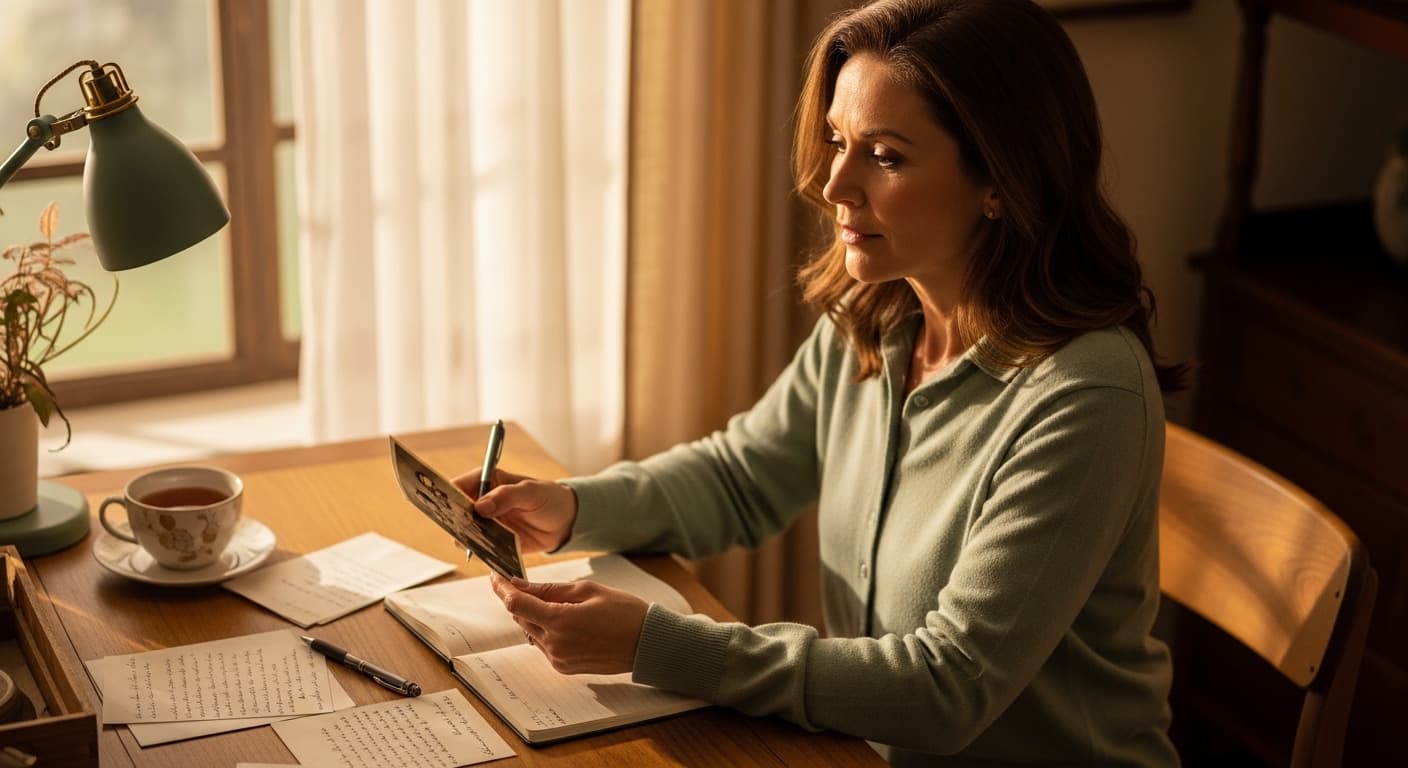
The best eulogy examples for a mother run 5–7 minutes (700–1,000 words), center on one defining quality she had, and use two or three specific stories to show who she was — not just what she accomplished. The most resonant tributes are the ones where people in the room nod and think: "That was exactly her."
Below you will find 22 complete, ready-to-adapt eulogy examples for a mother, organized by who is speaking and by tone: daughters (multiple examples capturing different relationships), sons, grandchildren, and those honoring a mother-in-law. There are short eulogies for when grief makes brevity necessary, religious examples for families of faith, and warm celebratory ones for mothers who would have wanted laughter in the room. Every example uses realistic names and specific details so you can see exactly how a finished eulogy reads — not a fill-in-the-blank template, but a real tribute you can adapt.
After the examples you will find a step-by-step writing framework, expert delivery tips, the most common eulogy mistake families make, and guidance on preserving her memory beyond the service. If you need a broader foundation first, our complete eulogy writing guide covers structure and format in depth. If you are honoring a father, see our eulogy examples for a father. This guide focuses entirely on honoring a mother.
Key Takeaways
Ideal length — 5 to 7 minutes (700–1,000 words) is the sweet spot funeral directors consistently recommend for services where multiple people are speaking
One defining quality — choose the single trait that best defined her and let every story orbit around it; eulogies with one strong thread are more moving than those that try to cover everything
Specific beats general — one vivid memory of her kitchen on Sunday mornings carries more weight than ten sentences of general praise like "she was always there for us"
Humor is welcome — if she was funny, honoring her with laughter honors who she actually was; bereavement researchers find appropriate humor helps the room process grief together
Print in 16-point font, double-spaced — hands tremble and eyes blur; phones lock at the worst moment; large print is a safety net, not a sign of unpreparedness
Have a backup reader — grief counselors advise asking someone you trust to hold a copy and step in if you need a moment; knowing the safety net exists often means you won't need it
How to Write a Eulogy for Your Mother: 6 Steps
Gather memories from siblings and family first
Before you write a single word, reach out to your siblings, your father, her close friends, and anyone who knew her from a different angle than you did. Ask each person: what is the one story about her that always comes to mind? These conversations surface moments you had forgotten or never knew — a college roommate's memory, a neighbor's story, a detail from before you were born. The process of gathering them is healing in itself, and you will almost always uncover the thread that makes your eulogy come alive.
Choose one thread that ties her stories together
Every mother is many things, but the strongest eulogies have a single through-line. Maybe she was the person who could defuse any argument with a well-timed comment. Maybe she was the quiet force who held everything together during the family's hardest years. Funeral celebrants consistently find that single-theme eulogies are more emotionally powerful than biographies that list every role she played. Ask yourself: what is the one word that comes to mind when I picture her? That word is your thread.
Open with a moment, not a general statement
Instead of beginning with "My mother was a wonderful woman," open with a scene: the smell of her kitchen on Sunday mornings, the way she answered the phone, the time she drove an hour in the rain to watch your school play. A specific moment places her in the room immediately and pulls the audience into your experience of her. The goal is to make people smile in the first thirty seconds because they recognize exactly who you are talking about.
Share two or three stories that show who she was
Choose moments that reveal her character, not her resume. The best eulogy stories have a small, vivid detail — what she said, how she reacted, where you were standing. These are the moments that make people smile through tears because they recognize the person you are describing. Avoid the instinct to summarize her whole life chronologically; two or three well-chosen scenes say far more than a decade-by-decade biography.
Acknowledge the loss honestly
Do not avoid the grief in the room. A single honest sentence about what the world lost — or what you personally lost — gives everyone permission to feel what they are feeling. Bereavement counselors note that this is often the most resonant part of a tribute, because it says aloud what the room is already holding. You don't need to dwell on it — one genuine sentence is enough.
Close with her legacy carried forward
End by telling the room what your mother gave you that you carry forward — the way you parent your own children, the values you live by, a phrase of hers that still guides your decisions. A eulogy that ends with legacy gives the audience something lasting to hold onto after the funeral service ends. It transforms the tribute from a goodbye into a continuation.
Eulogy Examples for a Mother from a Daughter
The bond between a mother and daughter holds its own particular language — a mixture of shared understanding, unspoken concern, and the kind of love that shifts shape over the years without ever losing its center. These seven examples capture different dimensions of that relationship: steady presence, immigrant resilience, the daily phone call, the kitchen as the center of everything, an honest tribute to a complicated relationship, a tribute to a mother lost young, and one written for a mother with dementia.
Example 1: "The Woman Who Made Everything Feel Safe"
Heartfelt eulogy from a daughter. Focused on emotional security and steady love. Approx. 310 words.
My mother, Margaret, had a way of making you feel like nothing bad could reach you as long as she was nearby. It wasn't anything dramatic — she didn't give speeches or make grand promises. It was the way she left the hallway light on when you were sick. The way she sat at the foot of your bed and rubbed your back without saying a word, because she understood that sometimes words were too much.
She was seventy-four years old, and for most of those years she tended to a garden in the backyard that the rest of us only half-appreciated. Every spring she would kneel in the dirt with her gloves and her trowel, arranging things in a way that seemed random to me but made perfect sense to her. When I asked her once why she spent so much time on flowers nobody could even see from the street, she said, "Rebecca, not everything has to be for other people. Some things are just for you." I think about that more than almost anything else she ever told me.
When I was twenty-three and came home after my first real heartbreak, Mom didn't ask what happened. She made tea, put a blanket on the couch, and sat next to me for two hours watching a cooking show neither of us cared about. At some point she reached over and squeezed my hand and said, "You are going to be fine. Not today, but soon." That was her genius — she didn't minimize what you felt, but she made you believe in the other side of it.
Dad once told me that when I was born, Mom held me for so long the nurses finally said they needed to take me for tests, and she looked at them and said, "Five more minutes." Apparently she said that four times. She spent my whole life asking for five more minutes — five more at the dinner table, five more on the phone, five more at the door when I left after a visit. I would give anything for five more minutes now. But I carry her with me in the things she planted — not just the garden, but the steadiness, the patience, the belief that showing up quietly is its own kind of courage. Mom, your hallway light is still on. It always will be.
Example 2: "She Taught Me Everything That Matters"
Eulogy honoring a mother who immigrated and built a life through resilience. Approx. 290 words.
My mother, Sunita, came to this country at twenty-six with two suitcases, a three-year-old daughter — me — and a conviction that things would work out if she simply refused to give up. She was right. Not because the world made it easy for her, but because she made it impossible for difficulty to have the last word.
She worked nights as a medical transcriptionist while studying for her nursing certification during the day. I remember waking up at five in the morning and finding her at the kitchen table, textbooks spread across every surface, a cup of chai going cold beside her. When I asked her why she was up so early, she said, "Priya, the hours before the world wakes up belong to you. Use them." I still wake up at five. I still hear her voice in those early mornings.
Mom taught me that dignity was not something anyone could give you or take from you. When a neighbor once made a dismissive remark about our cooking, she invited the woman over for dinner, served her the best meal she had ever made, and by the end of the evening they were exchanging recipes. She never mentioned the original comment. She didn't need to. That was her way — she responded to smallness with generosity, and she won every single time. She was not a soft woman in the traditional sense. She didn't sugarcoat things. But her version of love — practical, fierce, unflinching — was the foundation I built my entire life on. Mom, you taught me everything that matters. The rest I'm still figuring out, but I have your voice to guide me.
Example 3: "My First Phone Call, My Last Phone Call"
Eulogy about the daily bond of phone calls between a daughter and her mother, following a sudden loss. Approx. 290 words.
The first person I ever called on a telephone was my mother. I was four years old, Dad had shown me how to press the buttons, and I called her at work just to say, "Hi, Mommy." She told that story at every family gathering for thirty years, and every time she told it, she teared up at the same part — not the "Hi, Mommy" part, but the part where I said "Okay, bye" and hung up immediately. She said it was the first time she realized I was going to grow up and not need her the way I did at four. She was wrong about that.
My mother, Diane, was sixty-eight years old, and I spoke to her on the phone nearly every day of my adult life. Not long conversations — sometimes three minutes, sometimes twenty. She would call while walking the dog, and I could always hear the jingle of Baxter's collar in the background. She would ask what I had for lunch, whether the kids had done their homework, and if I had remembered to take my vitamins. It wasn't the content that mattered. It was the rhythm of it. It was knowing that at some point between noon and three, my phone would ring and it would be her.
When she passed suddenly last month, the thing that undid me wasn't the hospital or the service or the house full of flowers. It was one-fifteen on a Tuesday afternoon, when my phone didn't ring. I sat in my car in a parking lot and waited for it, even though I knew. The body learns a person's presence in ways the mind can't always override. Mom, every day around one-fifteen, I'm going to pause whatever I'm doing and think of you — because that's when the phone used to ring. That's when I used to hear your voice. That's when the world made sense.
Example 4: "She Made Ordinary Days Extraordinary"
A warm eulogy celebrating everyday moments and a mother's gift for the simple and memorable. Approx. 280 words.
My mother, Rosa, did not do anything the world would call remarkable, and she would have been the first to tell you that. She didn't run a company or write a book or climb a mountain. What she did, every single day for seventy-one years, was pay attention to the people she loved — and in doing so, she made the ordinary feel like something worth holding onto.
Her kitchen was the center of everything. On Saturdays she would start cooking by eight in the morning, and by noon the entire house smelled like garlic and tomatoes and the bread she insisted on making from scratch even though we all told her store-bought was fine. "Maria," she would say, wiping flour on her apron, "store-bought is for people who don't have time. I have time." She had time because she made time. That was her superpower — she treated the people around her as if they were worth the effort, always.
Every Sunday, our family gathered at her table. Not because anyone demanded it, but because no one wanted to miss it. Cousins, neighbors, my brother's college roommate who came for one dinner in 2004 and never stopped showing up — she fed them all. She never counted chairs or portions. She just cooked more, set another place, and made everyone feel like they were the guest she had been waiting for. Mom, your table is still set. Your family is still here. And every time I make your tomato sauce — which will never taste as good as yours, and we both know that — I will think of Saturday mornings in your kitchen, where the most ordinary things became the ones I miss the most.
Example 5: Honoring a Complicated Relationship with Honesty
A eulogy for a daughter whose relationship with her mother was difficult but real. A counterintuitive but powerful approach. Approx. 260 words.
My mother and I did not have an easy relationship. I think many of you in this room knew that, and I think Mom knew it too. We were too alike in some ways and too different in others, and for a long time that friction was what defined us. I want to be honest about that today, because I think she deserved honesty more than she deserved performance.
What I can tell you is this: she loved me in the way she knew how, and she knew how more than I gave her credit for when I was young. She showed up when I needed her — sometimes in ways I didn't recognize until years later. When I had my daughter, she drove three hours every week for six months without being asked. She never once said, "See? This is what I did for you." That restraint was its own kind of grace.
In her final years, we found something easier between us. We both stopped trying to change each other and started just being together. We talked on the phone most evenings. We argued about small things and laughed about smaller ones. We found, in the end, what had always been underneath the difficulty: a love that was stubborn enough to outlast everything else. Grief counselors often say that complicated relationships produce complicated grief — not less grief, but a kind layered with things left unsaid and roads not taken. I am carrying all of that today. But I am also carrying her voice, her particular laugh, and the way she always said my name like she meant it. That is what I am choosing to hold.
Example 6: "A Mother Lost Too Soon"
A eulogy for a daughter who lost her mother unexpectedly in her fifties — for when the loss comes before it feels like it should. Approx. 260 words.
My mother, Claire, was fifty-seven years old, and there is not a single person in this room who expected to be here today. That is the thing about losing a parent young — not the grief itself, which is the same as any grief, but the particular weight of all the years that were supposed to happen and didn't. The grandchildren she was going to spoil. The Sunday dinners still uncooked. The phone calls I haven't made yet.
Mom was the kind of person who made plans. She had a list on her refrigerator — things she wanted to do before sixty. She had already crossed off seven of them: she'd learned to kayak, visited Ireland, run a 5K, taken a pottery class, and seen the northern lights. She was working on the rest. She was always working on something, always moving forward, always curious about what came next. That spirit of looking ahead — I am choosing to see it as a gift she left us, not as a cruelty.
What I want you to know about her is this: she was fully present in every room she entered. She didn't look at her phone when you were talking to her. She remembered what you told her three months ago and asked about it. She made you feel, every time you were with her, that you were the most interesting thing that had happened to her that day. I don't know how she did it. I am going to spend the rest of my life trying to do it too.
Example 7: "She Was Still Herself, Even at the End"
A eulogy for a mother who lived with dementia in her final years — honoring who she remained beneath the illness. Approx. 260 words.
My mother, Joan, lived with dementia for the last five years of her life. I want to say something about that, because it shaped how we knew her in those years, and because I think the people who love someone through a long illness carry a particular kind of grief — the mourning that happens before the death, and then the mourning that happens after.
What I want you to know is that Mom was still herself. Not always in the ways we recognized. But she laughed at jokes even when she couldn't follow the setup. She reached for my hand when I sat next to her. She hummed along to songs she hadn't consciously remembered in years. The disease took her short-term memory, her ability to find words, eventually her ability to know my name. But it didn't take her warmth. It didn't take the way she looked at me with love even when she didn't know who I was.
Bereavement counselors speak about "ambiguous loss" — the grief of losing someone who is still physically present. We lived with that for five years. And now that she is gone, the grief is different: sharper in some ways, softer in others. What I feel most is gratitude. Gratitude for seventy-eight years of her life. Gratitude that we had five more years to sit with her, hold her hand, and let her know she was not alone. She was loved until the last moment. She knew it. We could see it.
“A mother is she who can take the place of all others but whose place no one else can take.”
Eulogy for a Mother from a Son
Sons often describe their mothers as the people who believed in them before they believed in themselves. These four examples explore the mother-son bond from different angles: a single mother who held everything together, a son honoring his mother's unconditional encouragement, a tribute built around kitchen memories, and a son finding words for a mother who wasn't given to sentiment.
Example 8: "The Strongest Person I Ever Knew"
A eulogy about quiet resilience, from a son honoring a single mother. Approx. 290 words.
My mother, Patricia, was the strongest person I have ever known, and I don't think she would have described herself that way. She would have said she was just doing what needed to be done. But I watched her do what needed to be done for forty years, and I can tell you — what she did required a kind of courage most people never have to find.
When my father left, I was nine and my sister was six. Mom sat us down at the kitchen table, looked at us with those steady brown eyes, and said, "Here's what's going to happen. I'm going to take care of everything. Your job is to be kids." She delivered that promise like it was simple. It was not simple. She worked two jobs for the next eight years — reception at a dentist's office during the day, bookkeeping for a landscaping company at night. I would hear her adding figures at the dining room table at eleven o'clock, her calculator clicking in the dark.
She never let us feel poor, even when we were. Our school clothes were always clean and pressed. Our lunches always had something homemade. When I needed cleats for soccer and we couldn't afford new ones, she found a pair at a thrift store, cleaned them until they looked brand new, and said, "James, it's not the shoes. It's the feet in them." I scored two goals in my first game wearing those cleats. She was in the stands for every game that season, still in her work clothes. Mom, you said your job was to take care of everything, and you did. Now it's my turn.
Example 9: "She Never Stopped Believing in Me"
A eulogy about unconditional support from a son who found his way slowly. Approx. 280 words.
My mother, Linda, had a phrase she used whenever I told her about something that went wrong — a job I didn't get, a relationship that fell apart, a plan that collapsed. She would listen to the whole story, nod slowly, and then say, "Well, Daniel, that's not the end of it." Not reassurance. Not advice. Just a calm refusal to let me believe that any single failure was the final chapter.
When I dropped out of college at twenty to start a business that failed in eight months, she didn't say I told you so. She said, "What did you learn?" When I went back to school at twenty-four and couldn't decide on a major, she said, "You'll figure it out. You always do, just slower than everyone else." She delivered that last part with a grin, because her encouragement always came with a small, affectionate dig. That was how you knew it was real. She came to every terrible apartment I ever rented and found something to compliment. She drove four hours to attend a work presentation I gave to twelve people in a conference room. Afterward, she said it was the most interesting thing she'd heard all year.
The year I finally found the career I'd been stumbling toward for a decade, I called her to share the news. She was quiet for a moment, and then she said, "Daniel, I never worried about you. Not once." I know that wasn't entirely true — I found a journal after she passed, and there were entries that suggested otherwise. But the fact that she never let me see the worry, that she showed me only the belief — that was the gift. Mom, every good thing I build from here has your fingerprints on it.
Example 10: "Her Kitchen Was Where Everything Made Sense"
A sensory eulogy centered on kitchen traditions and a mother who expressed love through food. Approx. 280 words.
If you want to understand my mother, Catherine, you need to start with her kitchen. It was a small room in a house that was never quiet, and everything that mattered to our family happened there. Arguments were settled there. Report cards were reviewed there. Holidays began there at six in the morning, when Mom would already be layering noodles for the lasagna and humming along to a Frank Sinatra record she'd been playing since before I was born.
She was seventy-two years old, and she cooked the way other people breathe — instinctively, constantly, without any apparent need for a recipe. I once asked her how much basil to put in the sauce. She held up her hand and said, "This much." When I asked what that meant in actual measurements, she looked at me like I'd asked her to explain gravity. "Michael, you taste it. That's how you know." Her cooking was how she told you she loved you. When my brother got divorced, she showed up at his apartment with three days' worth of meals in Tupperware. When I brought my girlfriend home for the first time, Mom made seven courses and watched her face after every bite. Afterward she pulled me aside and said, "She ate the eggplant. She's a keeper." We've been married eighteen years.
The last meal she ever made me was a pot of chicken soup on a Wednesday in November. I'd mentioned on the phone that I had a cold, and two hours later she was at my door, soup in hand, telling me I looked terrible and needed to go to bed. I was forty-six years old. She didn't care. Mom, I've been trying to make your sauce. The missing ingredient is you, standing at the stove, humming Sinatra, tasting from the wooden spoon. Everything you made needed another five minutes. Everything you gave us was worth the wait.
Example 11: "A Quiet Kind of Love"
A son's eulogy for a mother who wasn't naturally demonstrative but showed love through action. Approx. 250 words.
My mother, Frances, was not a woman who said "I love you" frequently. She came from a generation that showed love rather than announced it, and for most of my childhood I took that for granted. It wasn't until I was an adult and started paying attention that I understood the language she was speaking.
She showed up. That was the whole language. She showed up at my school play even though she'd worked a ten-hour shift. She showed up at my first apartment with a toolkit because she assumed, correctly, that I wouldn't own one. She showed up at my daughter's piano recitals for eleven years straight — never missed one, never complained about the drive — and afterward she would tell my daughter which piece was her favorite and why. She had opinions. She remembered. She paid attention.
Three days before she passed, she squeezed my hand and said, "You turned out good." That is not a phrase that will make it into any book of great literature. But it is the highest compliment she ever paid me, and I will carry it for the rest of my life. Mom, I know now — I always knew, I think — that every time you showed up, you were saying the thing you didn't say out loud. I heard every word.
Short Eulogy Examples for a Mother
Not every service calls for a lengthy tribute. A short eulogy — under 200 words — can be exactly right when grief is very fresh, when multiple family members are speaking, or when you simply want to say what matters most without elaboration. Brevity is not a lesser form of tribute; when every word carries weight, a short eulogy can be the most powerful one in the room.
Example 12: "She Was the Constant"
A simple, direct short eulogy for a mother named Helen, age 80.
My mother, Helen, lived eighty years, and in every one of them she was the most reliable person in any room she entered. She raised four children, nursed a husband through two surgeries, held three different jobs, and never once complained about any of it. She woke up early, she stayed up late, and in between she made sure everyone around her had what they needed.
She didn't want attention. She wanted you to eat your dinner, call when you got home safe, and show up on Sundays. That was all she ever asked for, and she gave back a thousand times more than she received. Mom was the constant in a world that kept changing. Now that she's gone, I realize how rare that is — someone who never wavered. I will spend the rest of my life trying to be that steady for the people I love. That's what she taught me.
Example 13: "Like a Light Left On"
A poetic, lyrical short eulogy for a mother named Grace, age 69.
Grace. That was her name, and she lived it. She moved through the world the way light moves through a window — gently, without force, filling up whatever room she entered. She was sixty-nine years old, and the people who knew her would tell you that knowing her felt like being welcomed into a place you didn't know you needed to find.
She loved morning walks, handwritten letters, and the sound of rain on the roof. She kept a journal every day for forty years. She once told me, "I write so I remember. Not the events — I remember those. The feelings. Those slip away if you don't catch them." Mom, I caught every feeling you ever gave me. The warmth. The safety. The certainty that someone in this world was always paying attention to whether I was okay. You were a light left on. And even now, I can still see by it.
Example 14: "Three Sentences at the Podium"
The shortest possible eulogy — for when grief makes speaking more than a few words impossible. Approx. 80 words.
My mother taught me that love is not a feeling. It is something you do every day, without applause and without guarantee of return. She did it every day for seventy-three years — for my father, for her children, for anyone who came through her door and needed a meal or a moment of kindness.
I can't tell you everything she was. There isn't enough time. But I can tell you that the world is smaller without her, and that everything good in me came from her. Thank you, Mom. We carry you forward.
Religious Eulogy Examples for a Mother
For families of faith, weaving scripture, prayer, or religious imagery into a eulogy can offer genuine comfort in the context of mourning. Funeral celebrants and clergy note that the most effective religious eulogies integrate faith naturally — as a reflection of how the person actually lived — rather than as a recitation of doctrine. These three examples demonstrate that balance across different traditions.
Example 15: A Christian Eulogy for Mom
A eulogy grounding a mother's life in Christian faith and the comfort of resurrection. Approx. 280 words.
My mother, Dorothy, was a woman of faith in the most literal sense of the word: she lived it. Not loudly. Not with lectures or judgment. She lived it in the way she treated strangers and the way she prayed every morning at the kitchen table before anyone else in the house was awake. I would sometimes come downstairs early and find her there, rosary in hand, the house quiet around her, and I would tiptoe back to bed because it felt like I was witnessing something private between her and God.
She believed in the resurrection with a certainty that I envied, and that I am leaning on today. The Twenty-Third Psalm was her psalm — she had it framed in the hallway, she quoted it at hard moments, and she asked us to read it at her service. "Yea, though I walk through the valley of the shadow of death, I will fear no evil." She walked through her share of valleys, and she did not fear them. That was the faith she passed to us.
What comforts me today is not just that she is at peace. It is that she believed this was not an ending. She believed, with her whole practical, unsentimental heart, that death is a door, not a wall. Mom, we are not saying goodbye. We are saying, "Go ahead. We'll follow when it's time." Save us a seat. You were always good at that.
Example 16: A Jewish Eulogy for a Mother
A eulogy drawing on Jewish values of tzedakah, memory, and legacy. Approx. 270 words.
In Jewish tradition, we say zichronah livracha — may her memory be a blessing. For my mother, Ruth, I have never heard a phrase that fit more perfectly. Her memory is already a blessing: it is the reason I know how to make brisket, why I call my children every Friday before Shabbat, why I put a pushke for charity on my kitchen counter even though I grew up thinking only grandmothers did that.
Mom was seventy-nine years old, and she spent those years doing what Judaism calls tzedakah — justice through generosity. She volunteered at the food bank for twenty years. She organized the synagogue's new family Shabbat dinners. She taught Hebrew school for a decade, and two of her former students are in this room today. She gave quietly, and she gave constantly, and she gave in a way that never made the recipient feel small.
She used to say that the opposite of grief is not happiness — it is gratitude. I am choosing gratitude today. I am grateful for seventy-nine years of her voice, her cooking, her honesty, her particular laugh at her own jokes before the punchline. I am grateful that she showed us what a life well-lived looks like, so that when we grieve her, we also know exactly what we are grieving: something real and rare and irreplaceable. Zichronah livracha, Mom. May your memory be a blessing, always.
Example 17: A Nondenominational Spiritual Eulogy
For families with general spiritual beliefs who want faith woven in without doctrinal specifics. Approx. 230 words.
My mother, Evelyn, believed in something larger than herself. She didn't call it by a particular name, and she didn't press her beliefs on anyone. But she lived as if kindness had cosmic weight — as if every small act of generosity mattered in a way that went beyond what we could see. She lit a candle every Sunday morning and sat quietly for ten minutes. I never knew exactly what she was doing in those ten minutes. I suspect she was just listening.
She believed in the continuity of love — that the people we lose don't disappear, they just change form. She said once, not long before she died, "When I go, I'm not going far. I'll be in the places you love, and in the things you do with care." I have thought about that sentence every day since. I find her in my garden. I find her in the way I make coffee in the morning and stand at the window for a moment before the day starts. I find her in my daughter's laugh.
Evelyn was eighty-three years old, and she lived every one of those years with her whole heart. If love is a form of energy that doesn't disappear — and I believe it is, because she taught me to believe it — then she is still here. Changed in form. Unchanged in essence. Mom, I'm still listening.
Funny Eulogy Examples for Mom: Celebrating Her Life
Some mothers would not want tears at their funeral service — they'd want laughter, warmth, and the kind of energy they spent their whole lives creating. A celebratory or humor-forward eulogy is not disrespectful. Bereavement researchers find that appropriate humor at memorial services helps attendees process grief, connects the community through shared memory, and honors the person's actual personality. If she was funny, honoring that is honoring her. These two examples demonstrate how to do it with love.
Example 18: "The Life of Every Room She Entered"
A warm, celebratory eulogy with humor for a mother named Barbara, age 75. Approx. 280 words.
My mother, Barbara, is probably somewhere right now rearranging the furniture and telling everyone the lighting could be better. If you knew her, you know that is not a joke. She once rearranged my living room while I was at the grocery store, and when I came home and stood in the doorway, stunned, she said, "You're welcome." She was right. It did look better.
Mom was seventy-five years old, and she hosted more dinners, parties, and "just because" gatherings than any person I have ever met. She kept a guest book — not the polite kind at a wedding, but a spiral notebook where she tracked who came over, what she served, and whether they liked it. If you made the mistake of saying you loved her potato salad, you received potato salad every time you visited for the next twenty years. She considered it a sacred obligation.
She had opinions about everything and shared them freely. She told my husband on their first meeting that his tie was ugly, and then she hugged him and said, "But you have a kind face, so I'll let it go." He's worn that tie to every family event since, just to make her laugh. It worked every time. Behind the humor was a woman who showed love by making sure no one in her orbit ever felt alone or unfed or unnoticed. Her house was always open — the door was literally never locked. She said, "If someone needs to come in, I don't want them to have to knock." Mom, we're all here because of you. The door stays unlocked. The potato salad will never be as good as yours, but we'll keep making it. And we'll keep laughing, because that's what you would want.
Example 19: "She Ran This Family Like a Small Country"
A humor-forward eulogy for a mother who was fiercely organized, opinionated, and the undeniable center of her family. Approx. 260 words.
My mother, Kathleen, ran this family the way some people run small countries: with a combination of logistical genius, selective enforcement of the rules, and an unshakeable certainty that her way was correct. We didn't always agree with her assessments. We always ended up doing things her way anyway.
She kept a laminated chore chart on the refrigerator until I was seventeen. She had a three-ring binder for every holiday that included a color-coded timeline, a budget spreadsheet, and a seating chart annotated with which relatives couldn't sit near each other and why. She once told my Aunt Carol that the family gift exchange was running twelve minutes behind schedule and that Carol needed to open her present faster. This is a true story. Aunt Carol has been telling it for fifteen years.
What we understood only later is that all of that organizing was love. Every laminated chart, every annotated binder, every opinion delivered without being asked — it was all her way of making sure we had what we needed, that the holidays felt special, that nobody fell through the cracks. She spent sixty-eight years making sure we were all okay, and she was very good at her job. Mom, we're going to try to manage without you. We're going to fail at it regularly, and we're going to miss you every time. But we'll think of you every time we're running twelve minutes behind schedule and someone needs to open their present faster.
“Grief is the price we pay for love. Every tear is a memory, every ache a testament to how much she mattered.”
Eulogy Examples for a Mother-in-Law
Writing a eulogy for a mother-in-law presents a particular challenge: you want to honor genuine grief and appreciation while acknowledging that others in the room knew her in ways you didn't. Funeral celebrants suggest framing a mother-in-law eulogy from your specific perspective — what she was to you, what she gave your family, and what her son or daughter inherited from her. These two examples take that approach.
Example 20: "She Welcomed Me Like I Had Always Belonged"
A daughter-in-law's eulogy for a mother-in-law who made her feel part of the family. Approx. 240 words.
I met my mother-in-law, Carolyn, twenty-two years ago, at a dinner where I was so nervous I spilled red wine on her tablecloth within ten minutes of arriving. She looked at the stain, looked at me, and said, "That is absolutely fine. Red wine is very hard to see on this pattern." There was no pattern. It was a white tablecloth. She said it anyway, because she had decided in that moment that I was going to be part of her family, and she wasn't going to let a wine stain stand in the way.
That was Carolyn. She made decisions about people — generous, final, wholehearted decisions — and she stuck to them. She decided I was worth keeping, and for twenty-two years she treated me accordingly. She called me every Sunday morning with a gardening tip whether I asked for one or not. She showed up with soup when I was sick. She gave my children the same fierce, particular love she gave her own children, and they adored her for it. I am a better mother because I watched her. I am a better partner because I saw what she and my father-in-law built together. Carolyn, I hope I was worth it. I am going to spend the rest of my life trying to be.
Example 21: Eulogy from a Son-in-Law
A son-in-law's tribute honoring his mother-in-law's influence on his wife and children. Approx. 220 words.
I want to start by saying that I know I am not the person who knew Eleanor best. Her children knew her best. Her grandchildren, who were the uncomplicated love of her later years, knew her in their own irreplaceable way. I knew her as the woman who raised my wife — and that, for me, is more than enough to stand here today.
My wife has her mother's laugh. She has her stubbornness, her directness, her habit of sending cards for every occasion including ones she invented herself — I received a "Congratulations on Surviving February" card once, and I treasured it. All of that came from Eleanor. When I want to understand my wife, I think about her mother. When I see my daughters starting to develop that same dry humor, that same way of listening with their whole attention — I see Eleanor in them, traveling forward.
She was gracious to me from the beginning, welcoming without smothering, interested without prying. She trusted me with her daughter, and she never once made me feel like I was on probation — which, looking back, I probably deserved. Eleanor, thank you for raising someone so extraordinary. Thank you for trusting me with her. We will carry you forward in every good thing she taught me to be.
Eulogy for a Grandmother from a Grandchild
When a grandchild is asked to speak at a grandmother's service, the perspective is uniquely precious — it captures a relationship without obligation or complexity, often just pure love. If you are a grandchild writing about your grandmother (who was also someone's mother), these tips and the example below can help.
Example 22: "She Always Had Time for Me"
A grandchild's eulogy for a grandmother who was the center of the extended family. Approx. 220 words.
I don't know who my grandmother was to the world. I know who she was to me: the person who always had time. Not time in a vague, general way. Specific time — time to sit at the kitchen table with me while I did my homework, asking me what I was learning even though I could tell she didn't always follow the math. Time to teach me how to make her biscuits, which she did slowly and without shortcuts even though she could have made them in half the time without me. Time to watch movies she'd already seen, because I wanted to watch them with her.
Grandma, Nana, Gran — she went by different names in this family, depending on how old you were when you met her. To me she was always Gran, which felt right because she was exactly what that word sounds like: warm, steady, permanent. You were supposed to be able to count on her the way you counted on gravity.
She was eighty-one years old, and I realize now that I knew her for only a fraction of the full life she lived. But the fraction I had was enough to change me. Gran, I'm going to learn to make your biscuits on my own now. They won't be the same. But every time I make them, I'll be spending time with you — which is all I ever really wanted.
The Most Common Eulogy Mistake — and How to Avoid It
Most guides tell you to "tell stories" and "be personal." That is true, but it misses the most common error families actually make: writing a eulogy that is entirely about the speaker's grief, rather than about the person who died.
A eulogy that spends most of its time describing how much you miss her, how lost you feel, and how nothing will be the same — is understandable and human, but it doesn't give the audience what they came for. They came to hear about her: who she was, what she did, the specific, irreplaceable details that made her the person they are mourning.
The test is simple: after every paragraph, ask yourself, "Is this about her, or about my feelings about her?" Feelings are welcome — they give the tribute emotional texture. But the subject of the eulogy should be her life, not your loss. The audience will feel your grief without being told about it. What they need from you are the details only you can provide.
- Instead of: "I don't know how I'm going to get through this without her..."
- Try: "She was the person I called for every decision. She had an opinion about everything, and she was right about most of it."
- Instead of: "The world will never be the same now that she's gone..."
- Try: "She made every room feel different just by being in it. You noticed when she arrived. You noticed when she left."
The grief is there in both versions. But in the second version, you are giving people a picture of who she was — something they can carry home with them.
Tips for Delivering Your Mother's Eulogy
Writing the eulogy is one thing. Standing in front of a room full of people who loved your mother and reading it aloud is another. In our experience helping families through memorial planning, the people who struggle most at the podium are those who practiced silently or not at all. These practical tips address what grief counselors and funeral directors consistently advise:
- Print in 16-point font, double-spaced. Your hands may tremble and your eyes may blur. Large, clear text gives you a safety net when emotion takes over. Do not read from your phone — phones lock, and unlocking one while crying is harder than it sounds.
- Practice out loud at least twice — once alone, once with someone you trust. Reading silently is not the same as hearing your own voice say the words. You will discover which sentences catch in your throat and can plan pauses around them.
- Bring water to the podium. Grief dries your mouth quickly. A small bottle of water is not a sign of weakness — it is the preparation of someone who takes this seriously.
- It is okay to cry. No one in that room expects you to be composed. If you need to stop, look at a fixed point in the back of the room, take three slow breaths, and continue when you are ready. The audience will wait for you.
- Have a backup reader ready. Give a printed copy to a sibling, a cousin, or a close friend and ask them to step in if you signal them. Knowing the safety net exists often means you will not need it.
- Aim for 5–7 minutes. A focused, heartfelt eulogy at five minutes is more powerful than a rambling one at fifteen. If multiple family members are speaking, coordinate beforehand to avoid overlapping stories.
One thing that consistently surprises people at the podium: once you begin speaking, the emotion often settles into something manageable. The anticipation of grief is frequently worse than the experience of it. Trust yourself. You were chosen to speak because the people planning this service believe you can do it.
If you are also helping plan the service, it may help to understand the differences between a memorial service and a funeral, as the tone and expectations for eulogies can differ between the two. You may also find our guide on what to say at a funeral useful if you're supporting others on the day.
Preserving Her Memory Beyond the Service
A eulogy marks a single day in the condolence period, but your mother's memory deserves a place that lasts. There are meaningful ways to keep her story alive long after the flowers have faded — ways that let family members near and far contribute to and revisit her legacy over time.
- Create a digital memorial — build a dedicated memorial page where siblings, grandchildren, and friends can share photos, stories, and memories. Unlike a eulogy, a memorial page grows over time as people add the moments they remember.
- Plant a memorial tree — a memorial tree is a living tribute that grows alongside your memories. Many families visit on her birthday or Mother's Day, creating a new tradition rooted in her name.
- Write her obituary with care — if you haven't yet, our guide to how to write a beautiful obituary can help you capture her life in a published format that becomes a permanent record.
- Collect her recipes, letters, and sayings — the details that made her who she was. Ask family members to photograph anything handwritten and compile it in a shared album or document everyone can access.
If you are also working on her obituary, our AI obituary writer can generate a thoughtful first draft based on the details you provide — giving you a foundation to personalize. You may also find inspiration in our collection of obituary examples.
Create a Lasting Memorial for Your Mother
Build a free digital memorial page where family can share photos, stories, and memories — keeping her legacy alive for generations to come.
Create a Free MemorialMemoriTree
MemoriTree editorial team.